I have so much to be thankful for, and the Bible addresses thankfulness so thoroughly, that I actually won't be able to post my article on Thanksgiving in time. Sorry! However, I did want to leave you with a couple of verses, to remind you why to be thankful and to Whom to be thankful.
James 1:17:
Every good thing given and every perfect gift is from above, coming down from the Father of lights, with whom there is no variation or shifting shadow.
James 1:2-4
Consider it all joy, my brethren, when you encounter various trials, knowing that the testing of your faith produces endurance. And let endurance have its perfect result, so that you may be perfect and complete, lacking in nothing.
Romans 8:28
God causes all things to work together for the good of those who love the Lord.
Realize this Thanksgiving that every good thing comes from the Lord--for which He should be thanked--and every seemingly bad thing He will cause to be a good thing. There is no person on this planet or in history who does not have reason to thank God--and thank Him endlessly. He should literally be thanked always and for everything (I'll get into that more in a future post.). Yet, setting aside a special day is okay, too, to specifically thank Him for all His many blessings and gifts.
Note: Because every good thing comes from God does not mean we can't thank people who have blessed us--it just means we should also thank God FOR those people.
I wish I could write more....in the future, Lord-willing.
Thanksgiving Blessings,
~Kingdom Advancer
Thursday, November 23, 2006


Tuesday, November 21, 2006
How Then Shall We Live?
When people reject what they should desire because they don't want to accept some of the other implications, the result is much worse than simply facing the truth and its consequences.
The following short discourse came into my mind as I was thinking of an atheist’s YouTube production that essentially said the world would be a better place if no one spent any time thinking about the possibility of heaven (after “proving Christianity and the Bible false by showing that Noah’s Ark and the Flood was impossible because races couldn’t have been established over such a short period of time from then to now”). Never mind the absolute absurdity of those claims…I dealt with that at that time. You’re welcome to comment and dismantle such allegations if you want to. But this article isn’t directly in reply to such claims. It, rather, just spawned out of thinking about them.
It’s interesting, many times my best inspiration comes in the form of pithy two-liners like these, if not in poetic form. I guess God designs us all differently with different talents, tendencies, and combinations of talents and tendencies.
The After-Life:
Live like there is no heaven, and you’ll never have to worry about going there.
Live like there is no hell, and that will become your eternal home.
Absolutes:
Live like there is no absolute good, and you will do little of it.
Live like there is no absolute evil, and you will do much more of that.
The Spiritual Realm:
Live like there are no angels, and they won’t hang around you.
Live like there are no demons, and they will never leave you.
God and Satan:
Live like there is no God, and He will never be your Father.
Live like there is no Satan, and he will forever remain your father.
Possession and Authority:
Live like your life is yours and yours only, and someday you will find it was Satan’s.
Live like you will never bow, and someday you’ll have no choice but to.
Soul’s Condition:
Live like you don’t have a soul, and yours will be dead forevermore.
Live like your soul is fine just as it is--without the saving blood of Jesus, and yours will be dead forevermore.
Materialism and Relativism:
Live like this life is all you get, and you will wish that you were right.
Live like you can’t know what the truth is, and you won’t like what you eventually find.
How Then Shall We Live?
Live knowing that there is a heaven and a hell. Act accordingly. (namely: salvation through Our Lord and Savior Jesus Christ and all that entails.)
Live knowing there is absolute good and evil. Do the former. Suppress the latter in the name of Christ.
Live knowing there is a spiritual realm. Allow the angels to help you. Shackle the demons in Jesus’ name.
Live knowing there is a God and a Satan. Pray for the Former to help you become His child and no longer the child of Satan .
Live knowing that your life can ultimately only belong to two entities—God or the devil. Dedicate yourself to the service of God.
Live knowing that souls do exist, in a stained state. Realize that human souls are the most important thing in the universe, and realize that we are all doomed—without Christ—to spiritual death. Act on these realizations.
Live knowing that you know the truth.
~Kingdom Advancer
The following short discourse came into my mind as I was thinking of an atheist’s YouTube production that essentially said the world would be a better place if no one spent any time thinking about the possibility of heaven (after “proving Christianity and the Bible false by showing that Noah’s Ark and the Flood was impossible because races couldn’t have been established over such a short period of time from then to now”). Never mind the absolute absurdity of those claims…I dealt with that at that time. You’re welcome to comment and dismantle such allegations if you want to. But this article isn’t directly in reply to such claims. It, rather, just spawned out of thinking about them.
It’s interesting, many times my best inspiration comes in the form of pithy two-liners like these, if not in poetic form. I guess God designs us all differently with different talents, tendencies, and combinations of talents and tendencies.
The After-Life:
Live like there is no heaven, and you’ll never have to worry about going there.
Live like there is no hell, and that will become your eternal home.
Absolutes:
Live like there is no absolute good, and you will do little of it.
Live like there is no absolute evil, and you will do much more of that.
The Spiritual Realm:
Live like there are no angels, and they won’t hang around you.
Live like there are no demons, and they will never leave you.
God and Satan:
Live like there is no God, and He will never be your Father.
Live like there is no Satan, and he will forever remain your father.
Possession and Authority:
Live like your life is yours and yours only, and someday you will find it was Satan’s.
Live like you will never bow, and someday you’ll have no choice but to.
Soul’s Condition:
Live like you don’t have a soul, and yours will be dead forevermore.
Live like your soul is fine just as it is--without the saving blood of Jesus, and yours will be dead forevermore.
Materialism and Relativism:
Live like this life is all you get, and you will wish that you were right.
Live like you can’t know what the truth is, and you won’t like what you eventually find.
How Then Shall We Live?
Live knowing that there is a heaven and a hell. Act accordingly. (namely: salvation through Our Lord and Savior Jesus Christ and all that entails.)
Live knowing there is absolute good and evil. Do the former. Suppress the latter in the name of Christ.
Live knowing there is a spiritual realm. Allow the angels to help you. Shackle the demons in Jesus’ name.
Live knowing there is a God and a Satan. Pray for the Former to help you become His child and no longer the child of Satan .
Live knowing that your life can ultimately only belong to two entities—God or the devil. Dedicate yourself to the service of God.
Live knowing that souls do exist, in a stained state. Realize that human souls are the most important thing in the universe, and realize that we are all doomed—without Christ—to spiritual death. Act on these realizations.
Live knowing that you know the truth.
~Kingdom Advancer
Monday, November 20, 2006
Remember This On Mothers' Day!
I've been trying to keep my posts themed to the time of year lately. But, I saw this while I was blog surfing, and I can't help myself. Hopefully this will hold you over until I can post something on Thanksgiving.
According to the original poster, this was on a billboard in London:
"If Evolution is true, how come mothers still have only two hands?"
Whether your mom is a Christian or an evolutionist, tell her this line. She should get a good laugh out of it, if nothing else.
~Kingdom Advancer
According to the original poster, this was on a billboard in London:
"If Evolution is true, how come mothers still have only two hands?"
Whether your mom is a Christian or an evolutionist, tell her this line. She should get a good laugh out of it, if nothing else.
~Kingdom Advancer
Friday, November 17, 2006
The Christmas Watch
Check out this blog I just started: The Christmas Watch. This is still my main blog, of course. I just want a convenient way for everyone to post news about Christmas. To see what I mean, go there and read the post. I want everyone to contribute, if they can. You can even become a team-member if you want to. It's not about origins or the virtue in Christians celebrating Christmas (or not). The battle over Christmas is just a small taste of a much bigger battle over Christ and people's souls, and this blog is about illustrating that battle through the venue of Christmas.
Oh, yeah, read my new post below, too, though.
~Kingdom Advancer
Oh, yeah, read my new post below, too, though.
~Kingdom Advancer
Is Anything Possible?

There is a great Hallmark Hall of Fame Christmas movie entitled A Season for Miracles. It’s one of my personal favorites. But I feel that one of the themes heavily intertwined in the movie is worthy of being discussed from a Christian perspective, although the makers and writers of the movie probably never intended it to be taken the way I’m going to discuss it. It is the idea that “anything is possible.”
If anything is possible, then I might someday be the President of the United States. (True statement)
If anything is possible, then I might someday be the President of the United States. (True statement)
But, if anything is possible, then I might die and reincarnate as President George W. Bush (Not true statement, by Christian—or just logical—standards)
If anything is possible, then you might get married (or re-married, for that matter) on June 17, 2014, at 2:15 p.m. in Honolulu, Hawaii. (True statement)
If anything is possible, then you might get married (or re-married, for that matter) on June 17, 2014, at 2:15 p.m. in Honolulu, Hawaii. (True statement)
But, if anything is possible, then homosexual marriage might be just as legitimate and sanctified (even by God) as traditional marriage. (Not true statement, from a Christian perspective)
If anything is possible, then you might someday be the parent of twenty-four children, adopted or hereditary. (True statement)
But, if anything is possible, then unborn babies might be just blobs of tissue, whose lives’ breath should be dependent upon the whims of pregnant women. (Not true statement, from a Christian worldview)
The problem with the magical statement “anything is possible” is that, if anything is possible, than anything is also NOT possible (or “possibly not”). This really violates the Christian faith, while at the surface it seems to tickle our imagination and beliefs. Examples:
If anything is possible, then Jesus Christ might have been the Son of God. But, if anything is possible, it is possible that Jesus Christ might NOT have been the Son of God.
If anything is possible, then Jesus Christ might have been right when He said that “no one comes to the Father but by" Him. But, if anything is possible, it is possible that there are other ways to heaven, and Jesus is NOT the only way.
If anything is possible, Jesus might have been born of a virgin. But, if anything is possible, Jesus might not have been born of a virgin.
If anything is possible, the Bible could be right that there is a hell. But, if anything is possible, then the Bible could possibly NOT be right and there might NOT be a hell.
If anything is possible, God might have created. But, if anything is possible, God might not have.
If anything is possible, the Bible might be the inerrant, infallible Word of God. If anything is possible, however, than it might not be.
If anything is possible, the Red Sea… If anything is possible, Noah’s Ark…. If anything is possible, if anything is possible, so on and so on.
I could make the list go on and on, but it kind of makes me sick to write it. I think you’ll understand.
So, in other words, if anything is possible, then nothing is certain. If Santa Claus might exist because anything is possible, Santa might also not exist because anything is possible (nothing is certain). The fact is, we could never know, could we?
The Bible tells us many things are certain. “In the beginning, God created…” (Genesis 1:1) “I am the Way, the Truth, and the Life, no one comes to the Father but by Me.” (John 14:6) “There is no other name under heaven given to men by which we might be saved.” (Acts 4:12) The Bible is full of unwavering truths. I’d virtually have to reprint the whole of the Scriptures to do this point justice.
The Bible isn’t even afraid of the word “impossible.” Why should God be afraid of it? He’d know if something was possible or not, wouldn’t He? The Bible says it is “impossible for God to lie,” (Hebrews 6:18) for example. It also says it is impossible to please God without faith (Hebrews 11:6).
So, as I’ve made clear, Christians have biblical, godly, and logical grounds to say that “anything—as in everything—is not possible, rather many things are certain.”
I really don’t want to sound like an old, dull, over-certain scrooge, especially since what most people mean when they say "anything is possible" is that "a borderline countless number of improbable and unexpected events can transpire." I think Christians should be wary of too often saying that something is not possible.. The conclusion that “anything is NOT necessarily possible” often leads to a materialistic worldview. “It’s just not possible that God _____” fill in the blank on the path to Deism, Agnosticism, Atheism, Relativism, Nominal Christianity, ad nauseam. That type of thought-processing is what really makes me want to believe that “anything is possible,” but those three words just don’t seem to fulfill my desires.
Christians do need to be cautious when speaking in absolutes, though. Have you ever heard the statement, “Nothing good can come out of this.” That’s about as unbiblical as you can get. The Bible says that “God causes all things to work together for the good of those who love the Lord.” (Romans 8:28) Plus, considering that God has an unchangeable plan/will, the aforementioned statement implies that God’s plan—although God’s perfect plan would be that all would be saved—is not good.
We need not limit God. He is the Author of Miracles, remember. The Bible says that “the things that are impossible with people are possible with God.” (Luke 18:27) Remember, “I can do all things through Christ Who strengthens me.” (Philippians 4:13) “With God, all things are possible." (Matthew 19:26; this passage and Luke 18:27 are synoptic)
The important thing to keep in mind is that all these things need to be taken in context. For instance, “With God,” it is NOT possible for God NOT to exist, is it? Of course not. I can NOT war against Christ “THROUGH Christ Who strengthens me.” A true statement is that God can do whatever He wants. But, God would never want to sin in any way, so some things, for all practical purposes, cannot be done “with” God’s approval or help.
On the other hand, though, the Bible tells us that we “can move mountains.” (Matthew 17:20) But we must always keep God’s will in mind. Take a lesson from the Master: Jesus prayed in the Garden of Gethsemane that the crucifixion might in some way be avoided. But He never latched onto the promise that “all things are possible.” He cared more for God’s will to be done. You could even make a compelling case that these Scripture verses I’m referencing--at their core-- actually mean “in God’s will.” With God = with God in His will ; through Christ = through Christ’s will.
Christians also need to avoid venturing outside the realm of biblical, godly absolutes into the realm of our own reasoning ability—or even our own stretched and varying interpretations of the Bible. Example for each case:
How many Christians do you think said that “man will never fly...period...” before the Orville Brothers’ time? How many do you think said afterwards that “I guess anything is possible”? Obviously, man still hasn’t figured out how to fly without assistance. But, people went outside the safe realm of absolutes and said that man will never learn how to fly when the Bible says nothing of the sort, and when the actual case was “man will probably never learn to fly.” We must be careful to not turn cases of probability or opinion into cases of certainty, but we must also not turn cases of absolutes into cases of probability (God does not probably exist; God DOES exist).
Interpreting the Bible is an even more precarious situation, because we must draw the line somewhere between clear biblical teaching/contextual interpretation and opinionated conjecturing. Glass pulpit or wooden? Real wine during communion or grape juice? These are exemplary of some debates going on in and between churches. Now, I'm not sure if these two things in particular are heated anymore--or if they ever really were--but, anyway, things that cannot be determined beyond a doubt as laid down in the Bible are often being treated that way in churches--where do you think we got so many denominations? Many split-off because of real concerns (whether the changes they made were biblical or not), but other differences between denominations are not so serious.
So where does this leave us? Here’s a summarization: ANYTHING IS POSSIBLE WITH GOD, THROUGH CHRIST, IN GOD’S WILL, AND CORRESPONDING TO THE ABSOLUTE PERAMETERS OF THE BIBLE.*As containing as that seems, it really is not. The “magic” of the Bible and the “magic” of the last two thousand years of God and Christianity are plenty optimistic, exciting, imagination-inducing, inspiring, and spontaneous for me. How about you?
~Kingdom Advancer
*This of course, doesn't necessarily--or overtly--pertain to more trivial matters, such as "could Temple beat Ohio State in football" or "can he fit twelve marshmallows in his mouth." Also, all these elements aren't necessarily essential at the same time. A Jesus-hating, Bible-disbelieving football team can win a game because of God's will. I'm speaking more of matters of truth or the Christian's life.
Monday, November 13, 2006
Air Force Memorial
 These are pictures of the recently completed and dedicated, $30 million Air Force Memorial, located in Arlington, Virginia, overlooking the Pentagon. Its design is inspired by one of the Air Forces' legendary and exhilirating in-flight maneuvers. I thought it was an appropriate post considering the recent passing of Veterans' Day.
 The Air Force is the last major branch of the military to be honored with such a memorial (although they probably have less majestic ones), even though the Air Force is playing an ever-increasing role in military operations.

The first photo shows President George W. Bush speaking at the memorial's dedication, and it gives a great illustration of the structure's massive size.
The second photo, although blurry, shows--in night perspective--the memorial in context of its location.
And the third photo appropriately catches the fly-by of military planes during the dedication ceremony.
 I can see where some Christians might have some qualms about supporting memorials and monuments. No good Christian wants to break the Second Commandment, by making a graven image for themselves. But, I think that such a fear is over-reaching, although it has troubled me for a while while I've been contemplating this post. But I think I've come to a relatively safe conclusion. Consider these things:
First of all, I think most people--and especially Christians--keep memorials in context. These memorials are to honor, acknowledge, and remember--not worship. These memorials don't--or shouldn't--take the place of God--at any level. Ancestor-worship was and is a popular thing, but Christians shouldn't have to forsake a memorial like this because of that ever-present fallibility of man. .
Secondly, we should remember that God had the Israelites build memorials. Critics might claim, "Yeah, but those were memorials to remember what God had done." Is this any different? For some, maybe, but for Christians I don't think so. God has done amazing things for and in this country, shedding his mercy, grace, and bountiful blessings, whether all will recognize that or not.
Plus, these men who serve in our military--whether they are Christians or not--stand for the Christian and moral principles of the United States of America. Although there are plenty of things to be ashamed of in America, like legalized genocide of the unborn, for example, America--as of now--still stands for many upright things.
Also, these memorials are meant for the honorable servicemen. It is meant for the men who fought and fight with honor; fought and fight with valor; fought and fight with mercy; fought and fight with an attitude of love and self-sacrifice; etc.. These are Christian principles. In contrast, for instance, there are no monuments for those at Abu-Graib. Those who run and ran from the battle; those who are and were traitors; those who care and cared more about themselves than their fellow soldiers; those who are bloodthirsty; those who are and were dishonorable in combat--they do not have to be grouped in--obviously--as "honored" by any memorials. I think that's the idea behind being "dishonorably discharged" or receiving the "Yellow Stripe," etc. In addition, we don't have to honor and revere the whole hero, so much as the heroism of the hero. We know that some soldiers have immoral lives and cheat on their spouses. We do not have to be ashamed that we respect and honor their service. We are honoring their service; not their sex-lives or alcohol-ingestion.
Context--as always--is essential. That is why we should honor those serving and who served and enjoy and support their memorials--while not putting them on "graven" pedestals.
Still though, this is a touchy and "high-wire" subject. How much is too much when honoring fallen, fallible men? Obviously, we realize that no one is anything without God's grace. We know that human nature is desperately wicked. But we also know that humans, as made in God's image and receivers of God's common grace, have the propensity to do good. But where do all those things leave us in this discussion practically? I'd appreciate your opinions.
And in conclusion, I want to thank our veterans once again.
~Kingdom Advancer
Prayer for the Air Force:
Dear God and Creator of the "wild blue yonder," keep watch over our men and women in harm's way. It says in Your Word that Your people will "mount up with wings like eagles." These soldiers are literally in the sky, Lord, and they need to have Your wind beneath their wings, and they need the protection of Your wings. Even if they themselves are not Christians, Lord, aid them so that they can defend the Christian principles America represents. Spare their lives so that they may do Your Will, knowingly or not, in protecting the innocent and the freedoms that You have so wonderfully worked through. But don't just protect their bodies, Lord: protect their souls. So that, "when [they] die, hallelujah, by and by, [they'll] fly away" to be with You.
As always, though, Lord, if Your Will be different than what I perceive, do it regardless of what I say.
In Your Son Jesus' name,
Amen.
Saturday, November 11, 2006
Thank You, Veterans!

I, like many others, have a true and great appreciation for our country's military servicemen. I admire them for their bravery and self-sacrifice that I aspire to possess. I could not know, it seems, though, unless I served myself.
Thoughts to carry with you on this Veterans' Day Weekend and throughout life:
If you can read, thank a teacher. If you can read in English, thank a soldier.
If there were no soldiers, you might be reading in German right now.
Freedom isn't free.
All gave some. Some gave all.
Freedom has a price the protected will never know.
The heart of this country: its patriots.
The backbone of this country: its patriots.
The substance of this country: its patriots.*
It's the soldier, not the campus organizer, who gives us freedom to demonstrate.
It's the soldier, not the reporter, who gives us freedom of the press.
It's the soldier, not the poet, who's given us freedom of speech.
It's the soldier who serves under the flag who defends the protester's right to burn the flag.
Isn't it time now to demonstrate that we support our troops?
Were it not for the brave, there would be no land of the free.
It is the American soldier who gives you the right to be "anti-America" and "anti-soldiers"--unpatriotic and anti-military.*
Let us never forget those who made the ultimate sacrifice for our freedom.
Let all know that freedom comes at a great sacrifice.
We should want them on that wall because we NEED them on that wall. Let us demonstrate to them that we SUPPORT them and LOVE them on that wall.*
Sacrifice does not diminish with time past: it gets better like wine.
Sacrifice does not need time to mature, however: it's precious immediately.*
Thoughts to carry with you on this Veterans' Day Weekend and throughout life:
If you can read, thank a teacher. If you can read in English, thank a soldier.
If there were no soldiers, you might be reading in German right now.
Freedom isn't free.
All gave some. Some gave all.
Freedom has a price the protected will never know.
The heart of this country: its patriots.
The backbone of this country: its patriots.
The substance of this country: its patriots.*
It's the soldier, not the campus organizer, who gives us freedom to demonstrate.
It's the soldier, not the reporter, who gives us freedom of the press.
It's the soldier, not the poet, who's given us freedom of speech.
It's the soldier who serves under the flag who defends the protester's right to burn the flag.
Isn't it time now to demonstrate that we support our troops?
Were it not for the brave, there would be no land of the free.
It is the American soldier who gives you the right to be "anti-America" and "anti-soldiers"--unpatriotic and anti-military.*
Let us never forget those who made the ultimate sacrifice for our freedom.
Let all know that freedom comes at a great sacrifice.
We should want them on that wall because we NEED them on that wall. Let us demonstrate to them that we SUPPORT them and LOVE them on that wall.*
Sacrifice does not diminish with time past: it gets better like wine.
Sacrifice does not need time to mature, however: it's precious immediately.*
They fight so that we may live in peace; they suffer imprisonment and torture so that we may live in freedom; they risk their present and future mental health so that we may have peace of mind; they lay down their lives so that we may LIVE.*
So that the Eagle of Freedom may fly in "spacious skies," they fly in hostile environments. So that the country may stretch safely from Sea to Shining Sea, they sail, submarine, and battle on the seas. So that America might remain "The Beautiful," they protect it in all conditions on land.*
If "there is no greater love than this, that one lay down his life for his friends," is not laying down one's life for country also a great love?*
"I'm proud to be an American, where at least I know I'm free. And I WON'T FORGET THE MEN WHO DIED, WHO GAVE THAT RIGHT TO ME. AND I GLADLY STAND UP, NEXT TO YOU, AND DEFEND HER STILL TODAY. CAUSE THERE AIN'T NO DOUBT I LOVE THIS LAND....GOD BLESS THE U.S.A." ("God Bless the U.S.A.," By: Lee Greenwood)
Thank you, veterans, for going from "the Halls of Montezuma to the Shores of Tripoli" for me, my and my country's freedom. (U.S. Marines)
Thank you, veterans, for going "over hill, over dale," being the "first to fight for the right." (U.S. Army)
Thank you, veterans, for going "off into the wild blue yonder, climbing high into the sun," willing to "go down in flame." (U.S. Air Force)
Thank you, veterans, for standing firm, never changing your course. (U.S. Navy) Thank you, veterans, for protecting our coasts, "from Aztec shore to Artic zone, to Europe and Far East." (Coast Guard)
Thank you, veterans, for fighting on land, sea, and air.
Thank you, veterans, for dying on land, sea, and air.
Thank you, veterans, for fighting and defending home and abroad.
Thank you, veterans, for dying home and abroad.
Thank you, veterans. *
If "there is no greater love than this, that one lay down his life for his friends," is not laying down one's life for country also a great love?*
"I'm proud to be an American, where at least I know I'm free. And I WON'T FORGET THE MEN WHO DIED, WHO GAVE THAT RIGHT TO ME. AND I GLADLY STAND UP, NEXT TO YOU, AND DEFEND HER STILL TODAY. CAUSE THERE AIN'T NO DOUBT I LOVE THIS LAND....GOD BLESS THE U.S.A." ("God Bless the U.S.A.," By: Lee Greenwood)
Thank you, veterans, for going from "the Halls of Montezuma to the Shores of Tripoli" for me, my and my country's freedom. (U.S. Marines)
Thank you, veterans, for going "over hill, over dale," being the "first to fight for the right." (U.S. Army)
Thank you, veterans, for going "off into the wild blue yonder, climbing high into the sun," willing to "go down in flame." (U.S. Air Force)
Thank you, veterans, for standing firm, never changing your course. (U.S. Navy) Thank you, veterans, for protecting our coasts, "from Aztec shore to Artic zone, to Europe and Far East." (Coast Guard)
Thank you, veterans, for fighting on land, sea, and air.
Thank you, veterans, for dying on land, sea, and air.
Thank you, veterans, for fighting and defending home and abroad.
Thank you, veterans, for dying home and abroad.
Thank you, veterans. *
note: Paragraphs denoted with a * is original--or mostly original--by Kingdom Advancer. Paragraphs without a * is either slightly adapted by Kingdom Advancer or not original. This is not plagiarism. The source of all these quotes and one-liners just aren't known to Kingdom Advancer at this time.
~Kingdom Advancer
~Kingdom Advancer
p.s. The Marines and Air Force both have recently been honored in new ways. I'll try to add links to those stories soon.
p.s.s. I often welcome comments and additions. This post is no different. If you have a good line or paragraph to add to these, please do.
God bless America....Land that I love...Stand beside her, and guide her, through the night with a light from above. From the mountains, to the prairies, to the oceans, white with foam! God bless America, my home sweet home. ("God Bless America," originally written by: Irving Berlin)
Friday, November 10, 2006
The Battle Resumes

True Story: A man walked into a post office. He asked the postal worker, "Do you have any Christmas stamps yet?" The employee responded, "Yes. They are up there," pointing to the upper left corner of a bulletin board. Three different pages of stamps were present. Perhaps a little hard to see, the man pointed to the first page and asked, "What are those?"
"Oh," the worker replied, "Those are for Hanukkah."
"Oh, I'm sorry," the man said. "I was looking for Christmas stamps." Then, looking at the second group of stamps, he asked, "What are those?"
"Oh, those are for Kwanza."
"Oh, I'm sorry," the man stated with a tad of sarcasm. "I'm looking for Christmas stamps." Thinking, "What's there to lose?" the man questioned, "Then what are those?"
"Those are Islamic."
The man turned away from the stamps--a bit frustrated--and said to the employee, "I guess you have mistaken me. Do you have any Christian Christmas stamps?"
"Oh, yeah," the employee assured. "I have some Madonna ones right here. I just haven't put them out yet."
The man turned and walked away from the desk, thinking, "Great. Catholic." He ended up purchasing snowflakes as his "Christmas" stamps.
Now, some might say that there's nothing wrong with Madonna-stamps, but--right or wrong--that's beside the point. The indisputable point is that there is a war going on over Christmas. It stays relatively stagnant in a stalemate for about eight to ten months of the year, but for those few months that it rages, it really rages. Many of those effecting Christ negatively don't even know it. They simply get sucked into erroneous ideas of "tolerance," "relativism," and then, of course, apathy. Even Christians fall into this trap. But, there are more concerted efforts. Like in everything else, secular humanists, secular progressives, and atheists want to take Christ out of the public square--really, the private square, too, in as many places as they can. They literally want to take Christ out of Christ-mas. I didn't even mention the conspiracy of Santa Claus (which I will blog about in the future) and the complete materialization of Christmas. Then, of course, you can't forget about the ultimate secularization of Christmas--calling it the "Winter Holiday."
So what do we do? Well, first of all, we shouldn't try to take away anyone's freedom to celebrate Hanukkah or Kwanza, etc., etc.. That's not what America is about, and it is not what Christianity is about. But the bottom line is that Christmas is Christmas, and no individual, organization, or even government should feel obligated to totally generalize the entire event. That would be taking away THEIR freedom. But why should Christians care?
Because, most importantly, I think, Christmas, like Easter, is an incredible witnessing opportunity. Even in this secularized world in which we live, the story of Jesus can't be totally hidden and smothered, because "Jesus is the Reason for the Season." Christmases come and Christmases go, admittedly, as people apathetically, arrogantly, and ignorantly ignore the story of Jesus and for what which it calls. Yet, once a year, Christmas comes around, beckoning to all with the beginnings of the Greatest Story Ever Told--the greatest truth ever known. If you need a conversation-starter to witness to someone, ice-breakers don't get much better than the Christmas story. People gravitate to it--and for good reason. People aren't offended by it, though they should be offended by their own sin. When you begin to explain the story of the First Christmas, though, and illustrate WHY Jesus had to come as He did and WHAT He did, then the Gospel message shines through fully as it should.
We need to get back, though, to what we should do. We all can't do the big things, obviously. We are all not James Dobson, or Albert Mohler, or George W. Bush, for that matter. But I've compiled a small list (in random order) of what EVERY Christian can do. I hope you will join in.
1.) Try to avoid using (in speech or writing) "Happy Holidays" or "Season's Greetings," or something similar. This generalizes Christmas--thereby taking Christ out of it--and frankly demotes it, if you know what I mean. Although they may seem appropriate for including "Happy Thanksgiving," "Merry Christmas," and "Happy New Year" in one package, try to use "Merry Christmas" as much as possible. If you want to reference the incoming year, say (or write) "Merry Christmas and a Happy New Year." It may seem like a mouthful, but it's worth it.
2.) Personally, I wouldn't even say or write "Holiday Blessings." This may be over the top, for, as I said, you may be wishing to refer to Thanksgiving, Christmas, and New Year's Day all-in-one, but if you are referring to the Christmas season in particular, say "Christmas Blessings," or, better yet, say "God Bless You." In fact, say that all the time.
3.) As I mentioned above, say "God Bless You," staying away from luck, the Fates, etc. You should do this all year round anyway. I'm reminded of the song Have Yourself a Merry Little Christmas. One line of lyrics says the following: "Through the years, we will all will be together, if the fates allow..." The song has been Christianized, to say this: "if the Lord allows..." Is that a small change? Yes, in all appearance, but I would suggest singing the Christian version, even if the version you are singing WITH is the "fates" rendition.
Before I lose you all, I want to add this sidebar. This may sound like nit-picking, or extreme, but as the saying goes, "Extreme times call for extreme measures. (Or desperate times call for desperate measures.)" If we are only going to do the little things, we need to do a LOT of the little things. Even if we are going to do big things, the little things give us the chance to never cease being a part of the battle. And we know our enemy, Satan and his minions, are incessantly fighting.
4.) When writing or typing, please don't use the terminology "xmas." Although it may seem convenient, it is the epitome of taking Christ out of Christmas. Here's an idea on how to use the "xmas" phenomenon, though:
An "x" is made from a "cris-cross." It is used in "xmas" to make "crismas"--Christmas. But notice the second part of the x: "cross." Cris-cross. Christ-cross. Christ ON the cross. I'm sure there's a witnessing tool in there. But for normal usage, I say avoid "xmas."
5.) I've already mentioned "Season's Greetings," "Happy Holidays," and "Winter Holiday." But, also, here's a reminder not to call the time off of school "winter break." It is Christmas Break. Although kids in year-round school might have a normal off-time in the winter, kids who do not have year-round school get two to three weeks off because of Christmas and the "sub-holidays."
6.) As I've alluded to, stay away from Santa. Santa is one of the biggest detractors from Christ, especially when it comes to children. Woe, that we would cause the little children to stumble! That we would lead them astray! That we would distract them from the greatest Gift and Gift-Giver of them all! Santa is a cutesy figure, and he can be parts of Christian celebrations relatively harmlessly, but if children and/or unbelievers are involved, he should not be.
Santa parallels Christ in some elements. Along with that, if Santa is put on the same level with Christ at Christmastime, when children grow out of believing in Santa, why would they believe that the story of Christ is real? If parents are willing to lie to their kids that "yes, Santa is real," why would the kids later believe their parents when they are told, "Yes, Christ is real"?
7.) Seventhly, we need to get Christ and the story of Christ back into the media and the mainstream. An effort is currently being made at that through The Nativity Story, coming out in December. I can't fully endorse the movie's content--as I am not familiar enough with the script--but I can say that the base idea is noble. There are movies en masse about Santa Claus every year. The same should go for Christ--from preceding stories preceeding his birth, to the actual birth, to the ramifications of His birth and life.
8.) Support stores like Wal-Mart and Kohl's (Update: Sears and Macy's, as well) for bringing the word Christmas back "in their vocabulary." Criticism and boycotts from Christians finally caused a change, and a reward for these stores from Christians should ensue. The pressure needs to stay on stores like Best Buy, although, as I said, they can do anything they want, just like Wal-Mart can say ONLY Merry Christmas if it wants to (although, of course, it doesn't). Read the story here.
9.) Get involved with Christian charity operations. One of my personal favorites is Operation Christmas Child. (If you know of others, feel free to post them.) This group ships shoe-box sized packages that you assemble to under-privileged children around the world, and simultaneously shares the Good News with these children. If you don't have time to purchase and assemble a present, you can simply donate funds.
10.) Don't be afraid to mention Jesus! That's what this holiday is about: celebrating His birth. We shouldn't hide our speech about Him in the home and church. As I mentioned, it's a GREAT witnessing opportunity.
11.) Lastly, don't forget to pray. As I have spoken of prayer before, I don't feel I need to add anything here, except to emphasize it. Our focus during Christmas should be salvation, and there is no better one to have the assistance of than the God of Salvation.
~Kingdom Advancer
Ever since Christ's birth, starting with Herod, effort after effort has been made to "exterminate" or "eliminate" Christ one way or another in one form or another. Modern-day Christians find ourselves in the midst of the same battle that caused Joseph and Mary to take Jesus to Egypt; the same battle that caused Christ's crucifixion; the same battle that the Apostles fought; the same battle that has caused millions of Christian martyrdoms; and the same battle that has resulted in several concerted efforts at the destruction of the Bible, either literally or "intellectually." Will we Christians stand up today?
Tuesday, November 07, 2006
Plans
 We must protect this flag, and the people and country it represents!!!
Two posts on politics in a row? Why not, especially since it's election time? Now, as I sort of implied in my last post, I don't want politics to be too spiritually polarizing. But, quite frankly, I think the divide between conservatives and liberals (and subsequently, Republicans and Democrats) is so stark that is has long ago become an issue of spirituality. Christian values versus non-Christian values, etc.. Therefore, I post this without qualms. By the way, I hope you voted. And if you haven't yet, I hope you have time to read this...and then vote.
First, as a precursor, I want to note that this post is actually a comment I made on another blog (sound familiar?). Go there by clicking here. Really, this is in reply to one anonymous, whose two quotes I will post first:
Ha. What's the President's plan? can he articulate it? I haven't heard him do anything other than bash Democrats....but its HIS war, what's HIS plan?
(several comments later)
How? how is he going to "finish the job" - when do we know its "finished" and again, i reiterate, "what is his plan?" Many members of Congress that authorized it are now calling for a change in policy and a change in leadership. So, what's the plan?
~ Anonymous
And now my turn:
Bush's plan, to put it simply: Protect America.
Democrats' plan: I can't really be sure.
Bush's plan: Use aggressive interrogation techniques on terrorist detainees in order to attain important information to protect Americans.
Democrats' plan: Go easy on detainees. As (I think) Bill O'Reilly says, "Democrats want to try to get information out of terrorists by giving them milk and cookies."
Bush's plan: Secure the border, by putting up a fence as well as other things.
Democrats' plan: [whistle of the wind]--perhaps amnesty and/or open borders?
Bush's plan: Surveil terrorist communications and monetary transactions.
Democrats' plan: Give terrorists and those in contact with them their "rights to privacy." Essentially, their rights to privately plot to slaughter Americans.
Bush's plan: Defeat worldwide terrorism on the terms, "If you're a terrorist--you're against us. If you harbor terrorists--you're against us."
Democrats' plan: Negotiate with terrorists. Try to appease them.
Bush's plan: Protect this country and defeat its enemies at all costs (no matter what others say).
Democrats' plan: Go through the U.N. at all costs (e.g., no matter how many resolutions are violated).
Bush's plan: Finish the job in Iraq. He realizes leaving the job unfinished would be disastrous. He also has said that the military constantly adapts. That's the plan. That's the good kind of "change" the American people should want.
Some Democrats' plan: Cut and run. (Big mistake)
Other Democrats' plan: Divide the country. (Also probably a big mistake.)
Almost all Democrats' vague plan: "CHANGE!" (Easy to say. Harder to do.)
I have to vent a little bit about that last line. Democrats criticize Bush for campaigning on "stay the course," but the Democrats could be criticized even more for their "the people want change" line. On a cold day, if cool water is the hottest you can get in the shower, do you turn the knob to ice cold for "the sake of change"? I don't think so. In the same way, although I don't see Republicans as "cool water," for those who do, I ask: why would that make you vote for Democrats [the "ice-cold" water]? If you don't like your leaky roof, why do you then decide to go out and sit in the mud and rain? That's how I see voting for Democrats for the sake of not liking how Republicans are handling Iraq.
Here's a jewel quote from an ordinary, Democrat voter (I'll leave out specific candidates names): "I really don't want to vote for [Republican candidate]. But I CAN'T vote for [Democratic candidate]--he's an idiot!"
Now, I'm not calling all Democrats idiots by association, but I do love that quote.
However, I want to remind everyone (although this may be too late, anyway) that not voting is NOT the answer. You should pick the lesser of two evils, so to speak, because if you abstain from voting, you essentially are choosing the GREATER of the two evils.
Also, I could go on about how Bush and conservatives protect Americans and the Democrats don't. For instance, Bush tries to protect the most innocent and vulnerable of humans--the unborn. Most democrats do not. Bush tries to protect the sanctity of a productive and culturally healthy institution--marriage. Many (perhaps most) Democrats don't. The list goes on into embryonic stem cell research, cloning, etc.,etc.
Clearly, someone who says Bush doesn't have a plan really means, "I don't like Bush and conservatives' and Republicans' plan."
~ Kingdom Advancer
Sunday, November 05, 2006
Kerry's Comments: Wrong, No Matter How You Twist Them

Yes, I disappeared off the face of the blogosphere for a week, and I apologize for that. I hope I haven't lost my readers. Anyways...I'm back.
If you pay any attention to politics or the news in general, then you've probably heard Senator John Kerry's comments many times over and the ensuing political and media clamor. Therefore, I find it unnecessary to repeat his comments here. However, this is a short post on the aforementioned topic. I've avoided politics to this point on my blog, but as an American after being a Christian, I think these types of topics are very relevant.
Notice that liberals are rambling on...and on...and on...about how Kerry's comments were just a botched joke about the President. They are willing to use various and far-out excuses to try to explain away his comments. But the bottom line: no matter WHAT Kerry meant, his intentions were either moronic or insulting--or both. And even if he didn't mean to insult the troops, he did.
1.) If he was insulting the President's education, he was being dishonest and/or ignorant.
2.) If he was insulting the President's intelligence, he was insulting 50+ million Americans who voted for him as their leader (Commander and Chief)--TWICE. And a lot of people still approve of him, despite what polls say.
3.) If he was insulting the President's education and intelligence, then the joke is on him, because he couldn't beat him for the presidency.
4.) If he was criticizing Bush's dedication--that he didn't "study up" or "do his homework" or whatever before going into Iraq--then he's essentially questioning Bush's patriotism--saying that Bush was too lazy or something to take his job seriously enough to do proper preparing. Sorry, John, but I don't think Bush's patriotism or dedication is in question.
5.) If he was insulting the preparation and execution of the war, he was insulting not only the President, but every high-ranking military personnel, advisor, counselor, etc., etc., all the way down to the troops on the ground.
6.) If he was criticizing Bush's decision to begin the war, then he was insulting the majority of congress--including himself (Remember: "I was actually for the war before I was against it"), who saw the same military intelligence the President saw and voted for the war.
7.) And lastly, if Kerry actually meant to criticize the troops--implying that our intelligent volunteer army is "stuck" in Iraq like soldiers were "stuck" in Vietnam, then he was actually insulting the troops and showed himself to be living way in the past.
Here's a few things to note:
a.) I find it interesting that the troops stand on hallowed ground, but our highest "troop"--the President of the United States--as well as his advising and brainstorming military leaders and advisors--seem to be considered fair game from the left. Where did the establishment and respect for rank go? Now, I have been known to be pretty hard on Former President Bill Clinton, but I think any intelligent, fair-minded person would admit that that's a totally different situation.
b.) Secondly, I think it would be astute to note that Kerry and liberals in general are at a disadvantage when trying to defend his comments. They have such a history of making debased comments about the military. Kerry himself has a history--both about Vietnam and Iraq. He accused our troops of "terrorizing women and children in their homes in the middle of the night" and said similar things about Vietnam. Other liberals have made many statements just like that.
c.)Thirdly, I've heard at least one liberal say, "Let's not forget that John Kerry is a war hero." But the term "hero" truly establishes itself as misused when calling Kerry a "war hero." President Bush didn't even serve in combat, yet I would consider him a "war hero" more than Kerry.
d.)And fourthly, the very fact of how long it took for Kerry to actually apologize (if he even has truly done that) really shows his true colors.
e.)Lastly, democrats are saying that republicans are trying to use Kerry's comments as a distraction--especially since Kerry isn't even up for re-election-- from the "real issues"--which were classified by one liberal analyst as including the "Foley and Hastert" situation. (Sure, the "real" issues.) I say: HELLO. This was the democrats' nominee for president!!! What he says is relevant--VERY relevant--when convincing people to vote conservative/republican rather than liberal/democratic.
~Kingdom Advancer
Thursday, October 26, 2006
Facing the Giants of Criticism
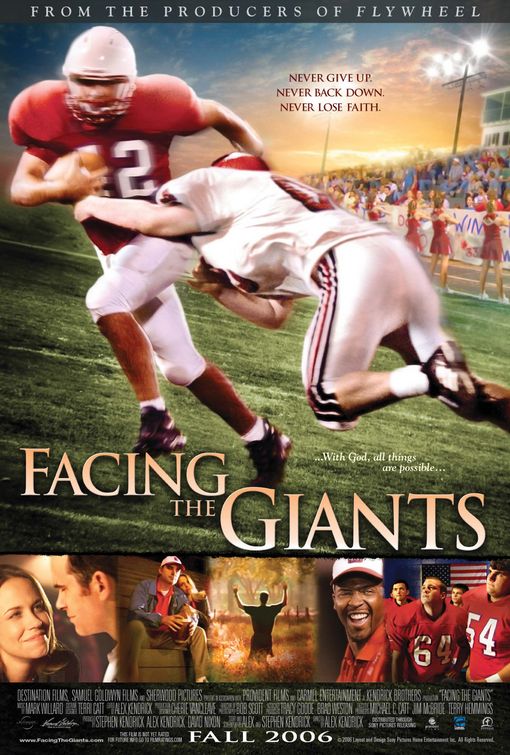 It doesn't take much more than seeing the commercial to know that the makers of Facing the Giants (made by Sherwood Pictures) faced just as large (or larger) specimens as the characters in the movie. Seemingly set-up for failure from the beginning, the production made by a Baptist church in Georgia utilized everything from volunteers to skateboard wheels to complete the movie for an "economical" sum of $100,000. Shaky acting, limited special effects, and a relatively un-original storyline all effect this movie, but Facing the Giants' very existence--and ensuing success--in and of themselves fell "giants"--the giant odds and the harsh critics.
The ironic thing is this: one of the major and more prominent criticisms of Facing the Giants is that it is too "preachy"--specifically, it "preaches to the choir." While I would agree that the movie could've had a greater influence and reach for God's Kingdom if it would have been less blatant and more convincing in its approach, I can't let the critics get away with this allegation.
The fact is, mainstream Hollywood is almost always "preaching to the choir." Hollywood preaches to the choir of those who are "lovers of pleasure rather than of God." (2 Timothy 3:4) It preaches to the choir of those who "love darkness rather than the Light." (John 3:19) It preaches to the choir of moral relativists. (John 14:6) It preaches to the choir of those who "do what is right in their own eyes." (Deuteronomy 12:8 ; Judges 17:6 ; Judges 21:25) It preaches to the choir of atheists, agnostics, and all others who lack a proper respect and fear of God. (Ecclesiastes 12:13-14 ; Matthew 10:28) It preaches in favor of desires for LACK of sexual, linguistic, and many other types of moral restraints. (See Sodom & Gomorrah--for example--and Ephesians 4:29) It preaches positively towards believers in the autonomy--and perhaps even the omnipotence--of man. (There's too many Scripture verses to even mention one here.) It preaches to the "survivors of the fittest," and the fittest. And sometimes--often in documentary form as in those done by Michael Moore--it even preaches specifically to extremist liberals, socialists, and conspiracy theorists. If I had to sum it up in one line, Hollywood often tickles the eyes and ears of Secular Humanists, or "secular progressives," as Bill O'Reilly (The O'Reilly Factor) calls them.
Many times these "sermons" are preached in deeds, not words. But if a picture says a thousand words, then how many words does a motion picture say?
I want to focus on one of these "preaching points" in particular: the autonomy of man, and the prevailing will or power of man. This is most relevant when discussing Facing the Giants. There are at least six sub-plots in Facing the Giants to go with the main, Cinderella football storyline. In a summary of brevity, these plots include: the coach and his wife trying to have a baby; a player on the team dealing with the responsibility of natural leadership; a player on the team with a bad relationship with his father; a player on the team who has a fear of failure and a crippled father; an older man who prays for all the students in the school every week; and the coach and his wife dealing with financial troubles.
In this movie, God is heavily intertwined in ALL plots. In the vast majority of other Hollywood productions, God is heavily intertwined in NONE of the plots. Sure, "miraculous" things happen, that "defy science," or go "against the odds," or "can't be explained," but they generally are contingent on a few things: the charity of another human; luck; the determined will and power of mankind; etc. The doctor can say, "You're pregnant; I don't know how that's possible, but you are." But if the miraculous occurrence is explained with the answer of God, it's "preachy." A high-schooler can say, "Dad, I'm sorry I disrespected you. I want to have a better relationship with you." But if he says, "Dad, I got right with God, and I've read in the Bible that I should respect you no matter what," that's "preachy." A crippled father can stand up to show his son strength and bravery, and tell his son, "Your best is all you can do, and if you fail, it's not the end of the world." But if he says, "I can do all things through Christ Who strengthens me"; or, "With God, all things are possible"; or, "God has not given you a spirit of fear"; or, "Do your best and leave the rest up to God"; or something along those lines, that's "preachy" or religiously loaded. A dad can give the head coach a new truck for being a good influence on his son, his son's teammates, and the rest of the school. But if he gives him the truck because of his godly influence, that's too Christian. And lastly, a team can play together with all their hearts, and the breaks can go their way, and they can beat the Giants. But, if the team plays together with all their hearts to the glory of God and it pleases God to grant them victory, that's wrong for entertainment--deserving of a bad rating.
The conclusion is this: what the critics mean when they say that a film such as Facing the Giants is overly religious or the product of fantasizing Christians is that the only acceptable set of beliefs in entertainment is that of atheism/secular humanism/liberalism/relativism/etc. They'd try to make you believe that such beliefs are "neutral," but that's just not true.
I'll admit, the monopoly on the entertainment industry has gotten even to me. Now, this may be due to poor execution (acting or scripting) by the makers of Facing the Giants, but it even felt weird to me to hear God mentioned so unflinchingly. However, just cause it feels different--unusual is the right word--doesn't mean it's wrong or bad.
And that's where the critics contradict themselves. They say that the storyline is too cliche. But despite the tendency to think that Facing the Giants is run-of-the-mill, the overbearing presence of God in and of itself makes this picture out of the mainstream, and it deserves credit for that. Maybe the critics could call it "edgy" or "fresh." (See last post)
Besides, even if Facing the Giants is cliche and predictable, and even if cliche, predictable football films are a dime-a-dozen, Facing the Giants deserves its share of the ten cents. It is a good movie in its own right. Remember the Titans is one of my favorite movies, and I know it's based off a true story, but I would've been perfectly okay if the producers had decided to be "cliche" rather than having a melancholy ending.
So, the critics say they don't like it because it's "too preachy," too predictable, and too cheap. But, as I said in my post Worthy of Our Hearts, Minds, and Money, I believe something much deeper than dislike is going on here in the entertainment industry, whether the critics (and others) involved know it or not. Of course, even if there is some type of malicious intent, it would never be admitted to. But, preconceived skepticism is surely held towards this movie because it was by a church. However, when you consider the strong and sometimes radical beliefs held by others behind common entertainment fare, the "man behind the curtain" excuse is another impertinent, unfounded argument.
Within and in spite of all this criticism, the making of the movie, followed by its monetary success, could possibly be considered a better story than the movie itself. According to Rotten Tomatoes , $5 million plus change (big-bills change) has been accumulated in ticket sales. That's gotta come as a shocker, especially to the critics whose reviews Rotten Tomatoes posts, who have collaborated to give it only 7 percent "fresh" (positive) reviews. Of course, when you compare that to the 90 percent positive Rotten Tomatoes' Users' rating, it seems rather conspicuous. The bottom line here, is this: critics, consider yourselves ineffectual. You are effective only in as much as what you consider effectiveness. You couldn't stop The Passion of the Christ despite--on Rotten Tomatoes--giving it only 51 percent fresh. You couldn't stop The Chronicles of Narnia (although this widely got rave reviews, several critics for prominent outlets trashed it--some on the basis of it being too Christian, or that's at least implied). And you don't seem to be stopping One Night with the King or Facing the Giants. Perhaps you should get started on your strategy for The Nativity Story and Prince Caspian right now. (By the way, I boast not in myself or in other Christians, but in my Lord and Savior Jesus Christ. [Galatians 6:14] Also, I realize that Jesus Christ does not have to show Himself through Christian movies' large dividends, but if He chooses to, I'll be glad to celebrate and give Him the glory.)
If you don't want to take time to do some math, I'll do it for you: Facing the Giants has received income--SO FAR--that exceeds its outgo by 50-fold!!! In other words, the Lord of the Rings trilogy, would've had to have made somewhere around $20 billion--IN THEATERS--to match!!!
Regardless of your critique of the execution--which I think is pretty good but can be fairly and vaguely summed up as "could've been better, could've been worse," this movie has such profoundly positive and Christian messages to portray that by themselves make this work worth seeing. Here's my list, in random order, of the messages this movie transmits [all these are biblical, but for the sake of publishing, I've decided not to have Scripture references here]:
1."If we win, we praise Him. If we lose, we praise Him."
2. Do everything for God and His glory.
3. Do your best, and leave the rest up to God.
4. God blesses the righteous and those who are in His will.
5. "Never give up. Never back down. Never lose faith."
6. Prayer changes things.
7. God supplies for our needs.
8. With God, all things are possible.
9. "Winning football games is too small a thing to live for."
10."We can't win football games if we don't play as a team."
11. The Bible can be applied to all aspects of life.
To read a fuller summary of the story of the movie and see other features, click here.
~ Kingdom Advancer
Post-Note: Favorite Element: Soundtrack: the Christian artists, like Casting Crowns, Bebo Norman, and Third Day, combined with an astoundingly impressive score, make this perhaps the highest production-value element of the movie.
*** If anyone has any other movies to add to my short "recent Christian success" list, feel free to do so.
****If anyone has any other messages they think Facing the Giants told that I don't have listed, feel free to comment with them, as well.
Monday, October 23, 2006
Worthy of Our Hearts, Minds, and Money
 King Xerxes (Luke Goss) crowning his beloved Esther (Tiffany Dupont) as queen.
 If you’ve seen one poor-quality Christian movie, then you’ve seen a couple dozen. And if you’ve seen one immoral Hollywood production, then you’ve seen a couple hundred.
It places the Christian in a predicament. Secular Hollywood has violated—in a bold manner—every reasonable and decent barrier that Christians, conservatives, moralists, and traditionalists alike have put up. Sexual promiscuity has become commonplace—and graphic, too—inside the theater. When Christian constituents finally conceded that—to get some “quality” entertainment—premarital sex and unmarried cohabitants had to be overlooked, Hollywood decided to enter the formerly off-limits realm of homosexuality. Actors and producers have taken to the Big Screen to promote everything from socialism to treason. Mindless violence ensues quite incessantly, and there are enough “gray areas” in many plots and storylines—about drugs, crime, sex, relationships, respect, honor, and all other things of right and wrong—to make a self-conscious middle-aged person with graying hair have a nervous breakdown. Foul language has contaminated PG-13 and even PG movies. If you didn’t know, PG-13 movies are “permitted” one F-word. Now, I never like to hear the F-word, but I certainly didn’t need or want to hear it as a 13-year-old, and I don’t want any 13-year-olds to hear it now. And don’t even think about going to a Rated R or NC-17 movie, unless you’re planning on washing your ears out with soap immediately afterwards.
The vast contingent of the Hollywood community is adamantly anti-Christian--in word and/or deed--and most Hollywood-ians think--for some strange reason--that the world cares what they think on issues of politics and religion. Rosie O’Donnell, I haven’t cared what you think since--well, come to think of it, I’ve never cared.
But, actually, Christians should care. When some actor, director, or producer is vehemently and openly anti-Christ; or when someone—like scientologist Tom Cruise—is dedicated to the retreat of God’s Kingdom through the means of direct attack or supporting some other belief system, should Christians support them with massive amounts of money? It seems like building up the enemy’s arsenal, supplying their M.R.E.’s, and shooting ourselves in the feet all at the same time.
On the other hand, Christian entertainment has become the punch-line to many a joke. Whether bad acting, bad casting, bad or overtly cliché and predictable plot, bad dialogue, bad filming, bad special effects, or blasé music, something seems to demolish almost every attempt at some truly Christian, truly wholesome entertainment. The culprits usually, at the base, are miniscule budgets and amateurs at the helms. Then, of course, there are the other issues: doctrinal disasters and filming faux-paus, as I call them. These especially show themselves in biblical productions by not-so-biblical people, if you will, but they can reveal themselves almost anywhere.. A few examples of the former case that I can think of are the network works of Noah’s Ark and The Ten Commandments. The latter: the recent End of the Spear, which lacks a strong Gospel message and presence and cast a homosexual activist as the lead role.
Then, of course, there are those that just seem kind of dull.
So what are Christians supposed to do? Should we curse the entire entertainment industry? Well, if I’m not mistaken, that’s been tried before, and the cursers generally become the cursed, missing out on the blessings of entertainment and giving Satan free reign to party in an entire industry. But, on one hand, a Christian does not/should not want to compromise his/her faith and risk giving Satan a “foothold/stronghold/opportunity” (Ephesians 4:27); but, on the other hand, even Christians—like me—will admit that watching some Christian films can be downright torturous and even embarrassing. So, again, what to do?
Well, fortunately, (praise be to God!) the oft accurate stereotype of evangelical pictures is beginning to be shattered. A good example of this is the (NOW IN THEATERS!!!) epic One Night with the King, the story of Esther, based on the novel Hadasseh by Tommy Tenney, which is based off the original book—Esther—from the Bible.
The biggest thing this movie has going against it is lack of publicity. If this film benefited from as much advertising as competing works like The Departed and Marie Antoinette, it would've entered the box-office charts a lot higher than ninth (It has sinced dropped to fourteenth, pulling only $2+ million dollars this past weekend compared to $4+ million when it opened). Plus the fact that it has gotten a pretty majoritatively negative response from critics. But what I say is this: at what point, exactly, do I give credibility to reporters for secular papers from places like Las Vegas and Los Angeles to comment on a moral, conservative, Christian film which possesses a sense of decency? For the Bible tells us that unbelievers love the darkness and hate the light(John 3:19)[note: critics seem to love movies that are "edgy," a.k.a. "grotesque and weird on a new level," even if the movies don't have the greatest of plots, acting, or production values], and that we will be "maligned" for our beliefs (Matthew 10:25). Now, of course, these critics and reporters probably would never admit to you that they actually despise God, Christians, and “the light,” but that’s also expected by the reader of the Bible: Satan himself--and by the way, I'm not calling these people Satan-- who is the “father of lies,” (John 8:44) “prowls” (1 Peter 5:8) around sneakily and poses as an “angel of light.” (2 Corninthians 11:14)
However, I can't be too hard on these guys, because One Night with the King has suffered criticism even from some Christian outlets, such as World Magazine and Christianity Today. And, besides, appraisals of movies are generally opinion based anyway, whether one is a professional critic or layman.
But, still, I know that this battle going on is much bigger than “us against Ted Turner” or something similar, but rather “against the principalities, the powers of the air, etc…” (Ephesians 6:12) However, since there have been many a poor-quality Christian production, that couldn’t be my sole reason. The main reason I’m so hard on these guys is because there is NO REASON THIS MOVIE SHOULD GET A BAD REVIEW. Sure, there may be a line here or there that smells of cheesiness, and a film trick once or twice that might be over the top or appear more fun to create than to watch, but there is nothing in this film that should get it as trashed as it has been. Call me biased, and I am and am glad to be so, but that’s not clouding my judgment. This is a quality movie of epic proportions. And the fact is, this is a battle going on: for the entertainment industry--which is another witnessing outlet.
Despite little publicity and bad publicity, One Night with the King raked in a surprising $4 million over its first weekend. Good news. Is there any bad news? Well, yes: the movie’s reported cost was $20 million!!! What does that mean? It means that it is time for word-of-mouth to take over. That’s what I’m doing here. I've seen the movie twice already, and it probably won't be in theaters much longer, so I strongly encourage you to see it within the next week or week and a half.
You see, the bottom line is this: to make money you have to spend money. Gener8xion Entertainment, Inc., has done that to the tune of $20 mil. But to spend money you have to have money. And for Christian efforts to have money, they usually have to be given money. Well, bless the souls of those who straight-out donated money to the cause or volunteered and physically helped, but the vast percentage of us can support it simply by seeing it and then talking to others about it.
Here is a brief review of the movie's various elements:
Biblical Accuracy:
I have been telling people One Night with the King takes artistic and interpretive liberties. In other words, for the sake of making a movie, they had to "stretch"--so to speak--some passages in the Bible. And for the sake of making everything make sense, they had to take some interpretive liberties. For instance, why did the head eunuch like Esther more than the others? Why did the king like Esther above all? Why were there those who were conspiring to kill the king (Was there someone--like a prince--behind it all?)? How did Mordecai find out about the plot? Why did Esther temporarily lose favor with the king? Why was Esther an orphan? Why did Haman hate the Jews? Why would the king be enticed into Haman's idea because of the Jews' money? Etc. What would make it easy to see Esther’s ethnicity—a necklace that reflects the Star of David. What would make it easy to note Haman’s beef with the Jews—a swastika-like medallion. The Bible concerns itself more with stating facts than telling a flowery story. I think this is probably for the best. If Noah’s Ark or the parting of the Red Sea sounded more like a story and less like historical record than it does, God’s Word would come under even more critical attack. And after all, the Bible is much more concerned with salvation than in telling good stories--especially since these "stories" are actual history. But, to make a movie interesting, enjoyable, and understandable, it is sometimes needed to expound upon the Bible. I mean, consider the amount of dialogue in any movie in comparison to the amount of dialogue in the book of Esther.
There are a few more serious transgressions of the movie: Esther only invites the king and Haman to one banquet in the movie, rather than two, like in the Bible; Esther has an interesting and improbable—to say the least—relationship with a Jewish boy who eventually is forced into being a eunuch (I say this, considering the time period and the Jewish people and traditions); and Haman doesn’t genuinely beg Esther for mercy in the movie, as the Bible gives the impression. There are also some other minor discrepancies I might’ve been able to mention, including the facts that Mordecai and Esther mention God in the movie, whereas the Bible does not--explicitly anyway; but the movie does not lose any core value and does not distract from the enjoyment of the film with any aforementioned “doctrinal disasters.”
Music:
So it’s not Lord of the Rings or Chronicles of Narnia when it comes to the score, but what’s the point of mentioning that? I say that no matter what movie I review the music of!!! The fact is, the score is epic and intense, and it serves its purpose well. I especially noted the love song that is in a different language.
Acting/Casting:
This is where One Night with the King shines in some areas and falls under attack in others, but, in my opinion, this is where it really separates itself from most other evangelical fare—both in name and in performance. Peter O’Toole plays a short-but-sweet role as the prophet Samuel. John Rhys-Davies couldn’t have played a better part than he did as the lovable, teddy-bearish Mordecai. Omar Sharif belts out at least a couple powerful and persuasive lines as a general. John Noble plays an eerie (and downright slimy) prince just as well as he played Denithor, Steward of Gondor, in the Lord of the Rings movies. Tommy Lister, like Rhys-Davies, comes across as very likeable in a great performance as the head eunuch. And Luke Goss, though certainly one of the worst of the cast, plays his part respectably and well-enough as the oft vexed and temperamental King of Persia.
Did I leave anyone out? ;) Oh, yes, of course, Tiffany Dupont. Beautiful and elegant, wistful and willful: Tiffany embodies everything about Esther that is traditionally imagined. A few too many giggles and childish lines might be considered to have pervaded and contaminated the performance, but I don't think so. Not to mention that her appearance’s “style” is at least believable as perhaps Jewish, unlike the last Esther movie, where Esther was played by an English woman with a strong British accent.
Special Effects/Sets/Wardrobe/Etc.:
Taking a page from Mel Gibson’s Passion of the Christ, the Crouch's weren’t afraid to make a quality movie. Although to the discerning eye—the kind that’s seen all the special features for Chronicles of Narnia and Lord of the Rings—some flyover footage might appear too computer-generated, it really is on par or above much Hollywood fare. Everything about the beautiful wardrobes and sets takes you back to Persia and to the truly epical nature of the situation.
Filming:
I guess you could say that there’s not too much new here, but Christians know that “there is nothing new under the sun,” or as I paraphrase: there’s nothing truly new under the sun. The filming is by no means dull, though, so why does it have to be new? A couple cheap artistic tricks find their way into the shooting, but whether this is detrimental or not really is a matter of taste and/or sensitivity.
Plot:
Does it get any better? The story of Esther is as inspiring and bravery-inducing as any story out there. It particularly makes you want to live for God and bring about His will.
As far as specific dialogue goes, some say that it's "pompous," "corny," "cheesy," etc., but that really has to be defined as specific lines--one here and maybe one there--NOT as a persistent parasite of the whole picture.
Summary:
There are some whose philosophies of movie-going are this: "If the critics don't like it, it's gotta be good." And vice-versa. My advice on this movie would be to see it--hands down. The good most definitely out-weighs the bad.
Favorite Parts:
1.) What Mordecai says when Haman asks why he refuses to bow.
2.) When Esther runs through the rain and bursts through the doors into the king’s court.
3.) When Esther is relayed the message of Mordecai, and replies, “If I perish, I perish.”
~Kingdom Advancer
What does it say about Christians if we are willing to pay for, watch, and enjoy works that have parts which compromise, violate, and war against our faith, but we can't support films putting forth efforts to advance God's Kingdom because certain parts go against our taste or aren't quite up to our highest of standards of quality?
Thursday, October 19, 2006
Fighting Back
In case you haven't noticed, the moral framework upon which the great country of America was built, and of which much of the world has known in the past, is degrading, diminishing, and disappearing seemingly more and more each day. In nearly every aspect of life, the dissolving of any sense of decency or morality is evident. However, also in nearly every aspect of life, battles are being fought by Christians and/or moral traditionalists to turn--or at least stem--the destructive tide of which I speak.
Think of the following: Evolution as the preferred "intellectual" and "scientific" explanation of our origins; the Ten Commandments removed from the public eye; chaplains having their religious freedom and honesty deprived of them; "In God we trust," "Under God," and other phrases attempting to be removed from landmarks and traditions; the homosexual and polygamist movements attempting to redefine marriage; anything vaguely Christian trying to be taken out of schools and off public property; the continuing epidemic of abortion; and, of course, the un-yielding progressing (actually digressing) moral degradation of TV and all other sorts of entertainment.
But, in almost all these areas, Christians and others who hold both common sense and a sense of decency are finally beginning to fight back--enthusiastically and often effectively. Here are some examples:
Origins:
Answers in Genesis is set to open their massive, professional, and expensive Creation Museum in 2007 in Northern Kentucky, within relatively convenient reach of Nashville, Tennessee; Cincinnatti, Ohio; Columbus, Ohio; Louisville, Kentucky; and even St. Louis, Missouri. I recommend you check out the links, but here's what you'll find on the front page of the museum's web page:
The 50,000 sq. ft. Creation Museum will proclaim the Bible as supreme authority in all matters of faith and practice in every area it touches on. Set to open in 2007, this “walk through history” museum will counter evolutionary natural history museums that turn countless minds against Christ and Scripture.
The Intelligent Design Movement, (click here for I.D. Net, here for Origins.org, and here for the Access Research Network) continues to make progress in getting a logical, intelligent, and scientific alternate to the Theory of Evolution into the school systems.
Countless other projects also are advocating in powerful ways the fact of Creation and the Creator, including one of the original efforts: the Institute for Creation Research. Other links can be found on my blog as well.
Ten Commandments:
Depending on where you live, you've probably seen little picket signs in front yards all over the place that have the Ten Commandments printed on them. Now, I live in a relatively conservative area, but it seems like I see one in every other yard. This is the result of efforts by Christians who want to restore and preserve America's moral and Christian heritage. One effort I suggest you check out is Written in Stone, although I'm sure there are other efforts. On this particular one's front page, it states an apparent battlecry: Every School, Every Courthouse. Then it states:
With over 75% of the country supporting the public display of the Ten Commandments, Written In Stone is empowering individuals, groups, businesses and even governments to take a stand to restore the heritage of this great nation. While many great organizations and ministries are taking a stand in many different areas, we are committed to be the lead voice in America on the Ten Commandments.
Use my link to find out more.
This is something encouraging I think about the Ten Commandments: The Ten Commandments have gotten more media and secular coverage since it has been attacked then ever before. Not to mention how it's one more thing that is getting Christians pro-active. You know what they say: don't wake a sleeping beast.
Issues of Politics and Religious Freedom:
Activists like Michael Newdow and organizations like the ACLU are constantly trying to destroy not only the religious freedoms of Christians, but also the heritage of America and any symbol of God on public property. On the other side of the coin, however, you can find organizations like the American Center for Law and Justice (ACLJ), headed by Jay Sekulow. This group of lawyers adamantly and effectively supports religious freedoms (including chaplains'), as well as other pr0-moral and pro-tradition ideals, such as traditional marriage. It is a formidable opponent for the ACLU's secular, atheistic, and amoral ideologies.
Marriage:
In this day and age, it seems to be becoming increasingly popular to think that marriage is "whatever we want to be." Yet, Christians know that's not so, and this thought-process is evidently not in the majority, for wherever a marriage amendment has been proposed or offered, it's been passed by the people.
Perhaps you've seen the bumper stickers that have a picture of a stick man, a plus sign, a picture of a stick woman, an equals sign, and a picture of a stick person family. In other words, it says "one man, one woman, equals a family [or marriage]." President Bush supports a constitutional amendment (to see an article from 2004 about the President's support, click here), and whether one is made could hinge on this upcoming election. Voting is as important as it's ever been. Also, there are some petitions that could be signed, but I don't know enough about them at present to endorse them publicly.
Abortion:
I think one of the biggest mistakes the Christian constituency could make would be to give up on the issue of abortion. Abortion is as unconstitutional, inhumane, murderous, grotesque, deplorable, and shameful as it has ever been. A significant percentage of Americans believe that abortion should be illegal except in cases that threaten the mother's life (and whether that is even appropriate is up for debate). So, what are pro-life people doing about it? Well, like most other issues conservatives and Christians face--not as much as they should be doing. But there are pro-life organizations and efforts out there, including the National Right to Life. And, like in other issues, battles are being fought and much again hinges on this election. Vote for life! If you can't vote, get involved where you'll have more than a one-vote effect!
Media:
If you didn't hear, "Air America," a liberal radio broadcasting network, filed bankruptcy. However, conservatives (many of whom are Christians), including Janet Parshall, Albert Mohler, James Dobson, Sean Hannity, Laura Ingraham, Bill Bennett, Hugh Hewitt, and others are doing quite well it seems. Talk radio--and TV--are big battlegrounds that obviously can't be ignored. Even if you don't agree with everything these people believe or their methods or personalities [I've got to admit, I don't agree on everything with everyone on this list] they're better than the flip side of the coin, aren't they? Even a character like a Bill O'Reilly, with his new book Culture Warrior, is fighting against the "secular progressives," as he calls them. Surely he's on Christians' side of the line in the sand, at least on some issues.
Note: I realize some people's qualms about joining people who aren't necessarily evangelical Christians. Those dilemmas are understandable. But issue by issue, I think it's important to stand for what Christians believe in, and sometimes non-Christians see things the same way Christians do, and I think it is necessary and appropriate to join with these people--issue by issue. Especially if protecting this country, protecting the unborn, protecting traditional marriage, protecting Christians' freedoms, or something similar is at stake.
~Kingdom Advancer
p.s. I covered the things I'm really concentrating on right now, but if anyone knows of any efforts, organizations, or persons on topics worthy of mention, let me know.
Think of the following: Evolution as the preferred "intellectual" and "scientific" explanation of our origins; the Ten Commandments removed from the public eye; chaplains having their religious freedom and honesty deprived of them; "In God we trust," "Under God," and other phrases attempting to be removed from landmarks and traditions; the homosexual and polygamist movements attempting to redefine marriage; anything vaguely Christian trying to be taken out of schools and off public property; the continuing epidemic of abortion; and, of course, the un-yielding progressing (actually digressing) moral degradation of TV and all other sorts of entertainment.
But, in almost all these areas, Christians and others who hold both common sense and a sense of decency are finally beginning to fight back--enthusiastically and often effectively. Here are some examples:
Origins:
Answers in Genesis is set to open their massive, professional, and expensive Creation Museum in 2007 in Northern Kentucky, within relatively convenient reach of Nashville, Tennessee; Cincinnatti, Ohio; Columbus, Ohio; Louisville, Kentucky; and even St. Louis, Missouri. I recommend you check out the links, but here's what you'll find on the front page of the museum's web page:
The 50,000 sq. ft. Creation Museum will proclaim the Bible as supreme authority in all matters of faith and practice in every area it touches on. Set to open in 2007, this “walk through history” museum will counter evolutionary natural history museums that turn countless minds against Christ and Scripture.
The Intelligent Design Movement, (click here for I.D. Net, here for Origins.org, and here for the Access Research Network) continues to make progress in getting a logical, intelligent, and scientific alternate to the Theory of Evolution into the school systems.
Countless other projects also are advocating in powerful ways the fact of Creation and the Creator, including one of the original efforts: the Institute for Creation Research. Other links can be found on my blog as well.
Ten Commandments:
Depending on where you live, you've probably seen little picket signs in front yards all over the place that have the Ten Commandments printed on them. Now, I live in a relatively conservative area, but it seems like I see one in every other yard. This is the result of efforts by Christians who want to restore and preserve America's moral and Christian heritage. One effort I suggest you check out is Written in Stone, although I'm sure there are other efforts. On this particular one's front page, it states an apparent battlecry: Every School, Every Courthouse. Then it states:
With over 75% of the country supporting the public display of the Ten Commandments, Written In Stone is empowering individuals, groups, businesses and even governments to take a stand to restore the heritage of this great nation. While many great organizations and ministries are taking a stand in many different areas, we are committed to be the lead voice in America on the Ten Commandments.
Use my link to find out more.
This is something encouraging I think about the Ten Commandments: The Ten Commandments have gotten more media and secular coverage since it has been attacked then ever before. Not to mention how it's one more thing that is getting Christians pro-active. You know what they say: don't wake a sleeping beast.
Issues of Politics and Religious Freedom:
Activists like Michael Newdow and organizations like the ACLU are constantly trying to destroy not only the religious freedoms of Christians, but also the heritage of America and any symbol of God on public property. On the other side of the coin, however, you can find organizations like the American Center for Law and Justice (ACLJ), headed by Jay Sekulow. This group of lawyers adamantly and effectively supports religious freedoms (including chaplains'), as well as other pr0-moral and pro-tradition ideals, such as traditional marriage. It is a formidable opponent for the ACLU's secular, atheistic, and amoral ideologies.
Marriage:
In this day and age, it seems to be becoming increasingly popular to think that marriage is "whatever we want to be." Yet, Christians know that's not so, and this thought-process is evidently not in the majority, for wherever a marriage amendment has been proposed or offered, it's been passed by the people.
Perhaps you've seen the bumper stickers that have a picture of a stick man, a plus sign, a picture of a stick woman, an equals sign, and a picture of a stick person family. In other words, it says "one man, one woman, equals a family [or marriage]." President Bush supports a constitutional amendment (to see an article from 2004 about the President's support, click here), and whether one is made could hinge on this upcoming election. Voting is as important as it's ever been. Also, there are some petitions that could be signed, but I don't know enough about them at present to endorse them publicly.
Abortion:
I think one of the biggest mistakes the Christian constituency could make would be to give up on the issue of abortion. Abortion is as unconstitutional, inhumane, murderous, grotesque, deplorable, and shameful as it has ever been. A significant percentage of Americans believe that abortion should be illegal except in cases that threaten the mother's life (and whether that is even appropriate is up for debate). So, what are pro-life people doing about it? Well, like most other issues conservatives and Christians face--not as much as they should be doing. But there are pro-life organizations and efforts out there, including the National Right to Life. And, like in other issues, battles are being fought and much again hinges on this election. Vote for life! If you can't vote, get involved where you'll have more than a one-vote effect!
Media:
If you didn't hear, "Air America," a liberal radio broadcasting network, filed bankruptcy. However, conservatives (many of whom are Christians), including Janet Parshall, Albert Mohler, James Dobson, Sean Hannity, Laura Ingraham, Bill Bennett, Hugh Hewitt, and others are doing quite well it seems. Talk radio--and TV--are big battlegrounds that obviously can't be ignored. Even if you don't agree with everything these people believe or their methods or personalities [I've got to admit, I don't agree on everything with everyone on this list] they're better than the flip side of the coin, aren't they? Even a character like a Bill O'Reilly, with his new book Culture Warrior, is fighting against the "secular progressives," as he calls them. Surely he's on Christians' side of the line in the sand, at least on some issues.
Note: I realize some people's qualms about joining people who aren't necessarily evangelical Christians. Those dilemmas are understandable. But issue by issue, I think it's important to stand for what Christians believe in, and sometimes non-Christians see things the same way Christians do, and I think it is necessary and appropriate to join with these people--issue by issue. Especially if protecting this country, protecting the unborn, protecting traditional marriage, protecting Christians' freedoms, or something similar is at stake.
Entertainment:
And that brings us finally to the realm of entertainment, what has long been becoming more and more a quagmire of sin and anti-Christian sentiment. But even in this spectrum, Christians are working so that Christianity and its values are making a come back.
Believe it or not, this article was originally going to be titled "The Movie Movement," but clearly there's been an unforeseen change of direction. Instead this article has been a quick overview and summarization of some of the hot issues facing Christian society today.
My main focus was going to be on the new Bible epic based on the Book of Esther and the novel Hadasseh by Tommy Tenney: One Night with the King. I also wanted to discuss Facing the Giants, a Christian football movie produced entirely by a Georgia [ I think] church for an economical sum (by Hollywood's standards) of $100,000. I even was planning on mentioning the upcoming Nativity Story and perhaps even discuss not as overtly Christian productions such as the Chronicles of Narnia, the Lord of the Rings, and the Passion of the Christ (yes, this is overtly about Christ, but some would say that it's overtly Catholic, not Protestant). I was even considering doing some research on some other projects that I'm sure are out there.
However, all that will have to wait for a later date. Bear with me, and I hope you enjoyed and got something out of this article.
Conclusion:
In conclusion, I should remind everyone that all of these efforts cannot be sustained without your and my support in four things:
1) Name
2) Deed
3) Finances
4) Prayer
Some efforts need names on petitions. Some efforts need volunteers, or at least help spreading the word about their projects and organizations. Some efforts need financial support, which can often be profitable, when you consider the tangible entertainment value of seeing Christian movies. And all of these efforts need prayer--lots and lots of prayer. It is the easiest thing of the four to do, but often it's the most neglected thing, as well. The Bible affirms and assures that we can do all things through Christ (Philippians 4:13); if we humble ourselves and pray, God will answer our prayers (2 Chronicles 7:14); nothing shall be impossible with God (Luke 1:37; Matthew 17:20; Matthew 19:26; Mark 10:27; Luke 18:27) ; if we delight ourselves in the Lord, He will give us the desires of our hearts (Psalm 37:4); and if we seek, we will find, knock, receive, ask, be given (Matthew 7:7-8; Luke 11:9-10)~Kingdom Advancer
p.s. I covered the things I'm really concentrating on right now, but if anyone knows of any efforts, organizations, or persons on topics worthy of mention, let me know.
Christians should be encouraged by the fact that there are battles for souls and societies going on right now. Win some, lose some, and some are stalemates--but battles none-the-less. This is not a peaceful takeover by the secularists, if they're winning at all.
Subscribe to:
Posts (Atom)


